
Choosing the right cookware can make everyday cooking easier, faster, and more enjoyable. With so many materials, sizes, shapes, and brands available, it can be difficult to know what is actually worth buying.
The good news is that you don’t need every type of pan on the market. The best cookware set for your kitchen depends on what you cook, how often you cook, your budget, and how much maintenance you’re willing to handle.
This complete guide will help you understand the most important cookware options and choose pieces that suit your kitchen needs.
1. Start With Your Cooking Habits
Before buying cookware, think about the dishes you prepare most often.
If you regularly make curries, dals, and stir-fries, versatile saucepans, kadais, and sauté pans may be your priorities. If you enjoy baking or roasting, sturdy oven-safe cookware will be more useful. For someone who frequently cooks pasta, soups, or rice, a good stockpot and saucepan can cover many everyday meals.
Ask yourself:
- What dishes do I cook most often?
- How many people do I usually cook for?
- Do I cook on gas, induction, electric, or multiple types of stovetops?
- Do I use an oven frequently?
- Do I prefer quick cleanup or don’t mind extra maintenance?
- What is my cookware budget?
Answering these questions can prevent you from spending money on pieces you rarely use.
2. Understand Different Cookware Materials
Cookware material affects cooking performance, durability, maintenance, and price. Here are some of the most common choices.
Stainless Steel
Stainless steel is a popular all-purpose option because it is durable, resistant to rust, and generally easy to maintain. High-quality stainless-steel cookware can provide excellent heat distribution when it has an aluminum or copper core.
It is particularly useful for boiling, sautéing, searing, and preparing sauces.
Best for: Everyday cooking, durability, and versatile use.
Nonstick
Nonstick cookware is valued for its easy food release and simple cleanup. It is particularly convenient for eggs, pancakes, delicate fish, and foods that tend to stick.
However, nonstick surfaces require appropriate utensils and care. Avoid overheating them and follow the manufacturer’s instructions for cleaning and use.
Best for: Low-fat cooking, delicate foods, and easy cleanup.
Cast Iron
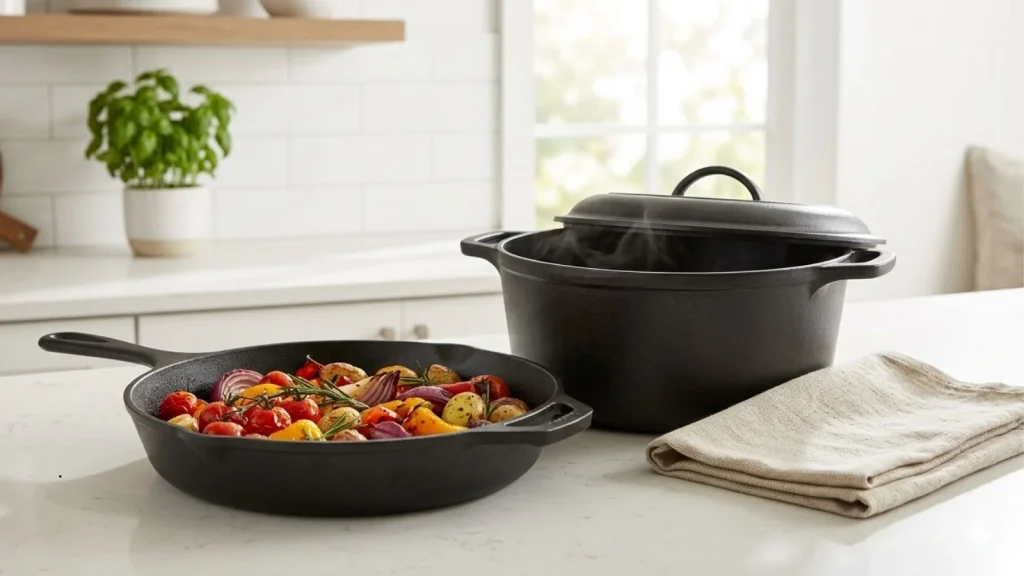
Cast iron is exceptionally durable and retains heat extremely well. It is excellent for searing, frying, roasting, and slow cooking.
The trade-offs are its weight and maintenance requirements. Traditional cast iron may also need seasoning to maintain its cooking surface and protect it from rust.
Best for: High-heat cooking, searing, roasting, and long-term durability.
Carbon Steel
Carbon steel combines some of the characteristics of cast iron with a lighter design. It can develop a naturally nonstick surface when properly seasoned and is particularly useful for high-heat cooking.
Best for: Stir-frying, searing, frying, and cooks who enjoy traditional cookware.
Copper
Copper responds quickly to changes in temperature and offers excellent heat control. It is often favored by professional and enthusiastic cooks.
The downside is that copper cookware can be expensive and may require more maintenance. Many copper pans also have a stainless-steel lining for practical everyday use.
Best for: Precise temperature control and serious cooking enthusiasts.
Ceramic
Ceramic cookware can refer to both fully ceramic cookware and metal cookware with a ceramic nonstick coating. Ceramic-coated pans can offer easy food release and an attractive appearance.
As with other coated cookware, proper care is important for maintaining the cooking surface.
Best for: Everyday cooking and those looking for an alternative to traditional nonstick surfaces.
3. Choose the Right Cookware Shapes and Sizes
Material isn’t the only factor. The shape and capacity of your cookware can make a major difference.
Frying Pan
A frying pan is one of the most useful pieces in any kitchen. It can be used for frying eggs, sautéing vegetables, cooking meats, making pancakes, and much more.
A medium-sized pan is suitable for everyday meals, while a larger pan is useful when cooking for several people.
Saucepan
A saucepan is ideal for sauces, soups, grains, boiling vegetables, and reheating food. A medium saucepan is a practical choice for most households.
Sauté Pan
With straight sides and a broad cooking surface, a sauté pan provides more capacity than a typical frying pan. It is useful for vegetables, curries, meat, and one-pan meals.
Stockpot
A stockpot is designed for larger quantities of food. It is useful for pasta, soup, stock, stews, and cooking for gatherings.
Dutch Oven
A Dutch oven is a versatile, heavy-duty pot that can be used for slow cooking, braising, soups, stews, and, depending on the model, baking.
Kadai or Wok
For Indian and Asian cooking, a kadai or wok can be extremely useful. Its shape makes it suitable for frying, sautéing, stir-frying, and preparing dishes with sauces or gravies.
4. Consider Your Stovetop
Not all cookware works equally well on every cooking surface.
If you have an induction cooktop, cookware needs a magnetic base or otherwise needs to be specifically labeled as induction-compatible. Stainless steel, cast iron, and some other materials can work well with induction, but compatibility should always be checked before purchase.
For gas stoves, most cookware materials work well, although the pan’s base and construction can affect heat distribution.
If you use more than one type of cooktop, choosing versatile, multi-surface-compatible cookware can save you from replacing your collection later.
5. Think About Heat Distribution
Good cookware should distribute heat relatively evenly rather than creating extreme hot spots.
Look for cookware with a well-constructed base, particularly if you frequently cook foods that require consistent temperatures.
Multi-layer or “clad” cookware often combines different materials to balance durability, heat distribution, and responsiveness.
6. Don’t Ignore Handles and Lids
A pan can have excellent cooking performance but still be frustrating to use if the handle is uncomfortable.
When evaluating cookware, consider:
- Is the handle comfortable to hold?
- Does it stay reasonably cool during normal stovetop cooking?
- Is the pan balanced?
- Is the lid secure?
- Is the lid heat-resistant and easy to grip?
- Can the cookware safely go into the oven?
A transparent lid can also be useful when you want to monitor cooking without constantly lifting the lid.
7. Check Oven and Dishwasher Compatibility
If convenience matters to you, check whether your cookware is dishwasher-safe. However, dishwasher compatibility can vary by material and manufacturer, and hand washing may help preserve certain finishes.
Similarly, not every pan is oven-safe. Some cookware has temperature limitations because of its coating, handles, lids, or construction.
Always check the manufacturer’s specifications rather than assuming a pan can safely go from stovetop to oven.
8. Build Your Cookware Collection Gradually
You don’t need to purchase a huge cookware set immediately.
A practical starter collection might include:
- One versatile frying or sauté pan
- One medium saucepan with a lid
- One larger pot or stockpot
- One kadai or wok if you regularly prepare stir-fries or Indian dishes
- One oven-safe pan or Dutch oven if you frequently roast or slow-cook
Once you know what you actually use, you can add specialized pieces.
Buying individual cookware pieces can sometimes be more practical than purchasing a large set filled with pans you rarely use.
9. Balance Quality and Budget
The cheapest cookware isn’t always the best value, but expensive cookware isn’t automatically better either.
Instead of focusing only on price, consider durability, construction, warranty, cooking performance, and how frequently you will use the item.
A high-quality pan that you use several times a week may provide more value than an inexpensive set containing numerous pieces that remain in the cupboard.
10. Maintain Your Cookware Properly
Even excellent cookware can deteriorate when it isn’t cared for correctly.
Use the manufacturer’s cleaning instructions, avoid sudden temperature changes when they may damage the cookware, and use appropriate utensils for coated surfaces.
For cast iron and carbon steel, proper seasoning and drying are particularly important. For nonstick cookware, avoid metal utensils unless the manufacturer specifically says they are safe.
Good maintenance can significantly extend the useful life of your cookware.
Common Cookware-Buying Mistakes to Avoid
Buying a Large Set Without a Plan
A 12-piece cookware set may look like a bargain, but some pieces may rarely leave your cupboard.
Choosing Based Only on Appearance
Beautiful cookware can enhance your kitchen, but cooking performance, construction, and compatibility should come first.
Ignoring Cooktop Compatibility
This is particularly important for induction users. Always confirm compatibility before purchasing.
Buying Too Many Specialized Pans
A versatile frying pan or sauté pan can often perform several jobs. Build your collection around your actual cooking habits.
Overlooking Maintenance
Consider how much time you are willing to spend cleaning, seasoning, and caring for cookware before choosing a material.